Practicing Mindfulness & Self Compassion
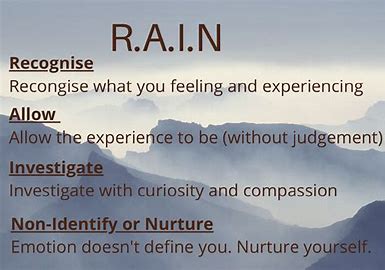
The acronym RAIN is an easy-to-remember tool for practicing mindfulness and compassion using the following four steps:
Recognize what is going on;
Allow the experience to be there, just as it is;
Investigate with interest and care;
Nurture with self-compassion.
You can take your time and explore RAIN as a stand-alone meditation or move through the steps whenever challenging feelings arise.
R—Recognize What’s Going On Recognizing means consciously acknowledging, in any given moment, the thoughts, feelings, and behaviors that are affecting us. Like awakening from a dream, the first step out of the trance of unworthiness is simply to recognize that we are stuck and subject to painfully constricting beliefs, emotions, and physical sensations. Common signs of the trance include a critical inner voice, feelings of shame or fear, the squeeze of anxiety or the weight of depression in the body. Recognizing can be a simple mental whisper, noting what has come up.
A—Allow the Experience to be There, Just as It Is Allowing means letting the thoughts, emotions, feelings, or sensations we have recognized simply be there, without trying to fix or avoid anything. When we’re caught in self-judgment, letting it be there doesn’t mean we agree with our conviction that we’re unworthy. Rather, we honestly acknowledge the arising of our judgment, as well as the painful feelings underneath. Many students I work with support their resolve to pause and let be by silently offering an encouraging word or phrase to themselves. For instance, you might feel the grip of fear and mentally whisper, Yes, or It’s ok, in order to acknowledge and accept the reality of your experience in this moment.
I —Investigate with Interest and Care Once we have recognized and allowed what is arising, we can deepen our attention through investigation. To investigate, call on your natural curiosity – the desire to know truth – and direct a more focused attention to your present experience. You might ask yourself: What most wants attention? How am I experiencing this in my body? What am I believing? What does this vulnerable place want from me? What does it most need? Whatever the inquiry, your investigation will be most transformational if you step away from conceptualizing and bring your primary attention to the felt-sense in the body. When investigating, it is essential to approach your experience in a non-judgmental and kind way. This attitude of care helps create a sufficient sense of safety, making it possible to honestly connect with our hurts, fears and shame.
N—Nurture with Self-Compassion Self-compassion begins to naturally arise in the moments that we recognize we are suffering. It comes into fullness as we intentionally nurture our inner life with selfcare. To do this, try to sense what the wounded, frightened or hurting place inside you most needs, and then offer some gesture of active care that might address this need. Does it need a message of reassurance? Of forgiveness? Of companionship? 3 Of love? Experiment and see which intentional gesture of kindness most helps to comfort, soften or open your heart. It might be the mental whisper, I’m here with you. I’m sorry, and I love you. I love you, and I’m listening. It’s not your fault. Trust in your goodness. In addition to a whispered message of care, many people find healing by gently placing a hand on the heart or cheek; or by envisioning being bathed in or embraced by warm, radiant light. If it feels difficult to offer yourself love, bring to mind a loving being – spiritual figure, family member, friend or pet – and imagine that being’s love and wisdom flowing into you. When the intention to awaken self-compassion is sincere, the smallest gesture of turning towards love, of offering love – even if initially it feels awkward – will nourish your heart.
After the RAIN: When you’ve completed the active steps of RAIN, it’s important to just notice your own presence and rest in that wakeful, tender space of awareness. The fruit of RAIN is realizing that you are no longer imprisoned in the trance of unworthiness, or in any limiting sense of self.
You can practice this technique as part of a guided visualisation on You Tube: https://www.youtube.com/watch?v=W8e_tAEM80k